
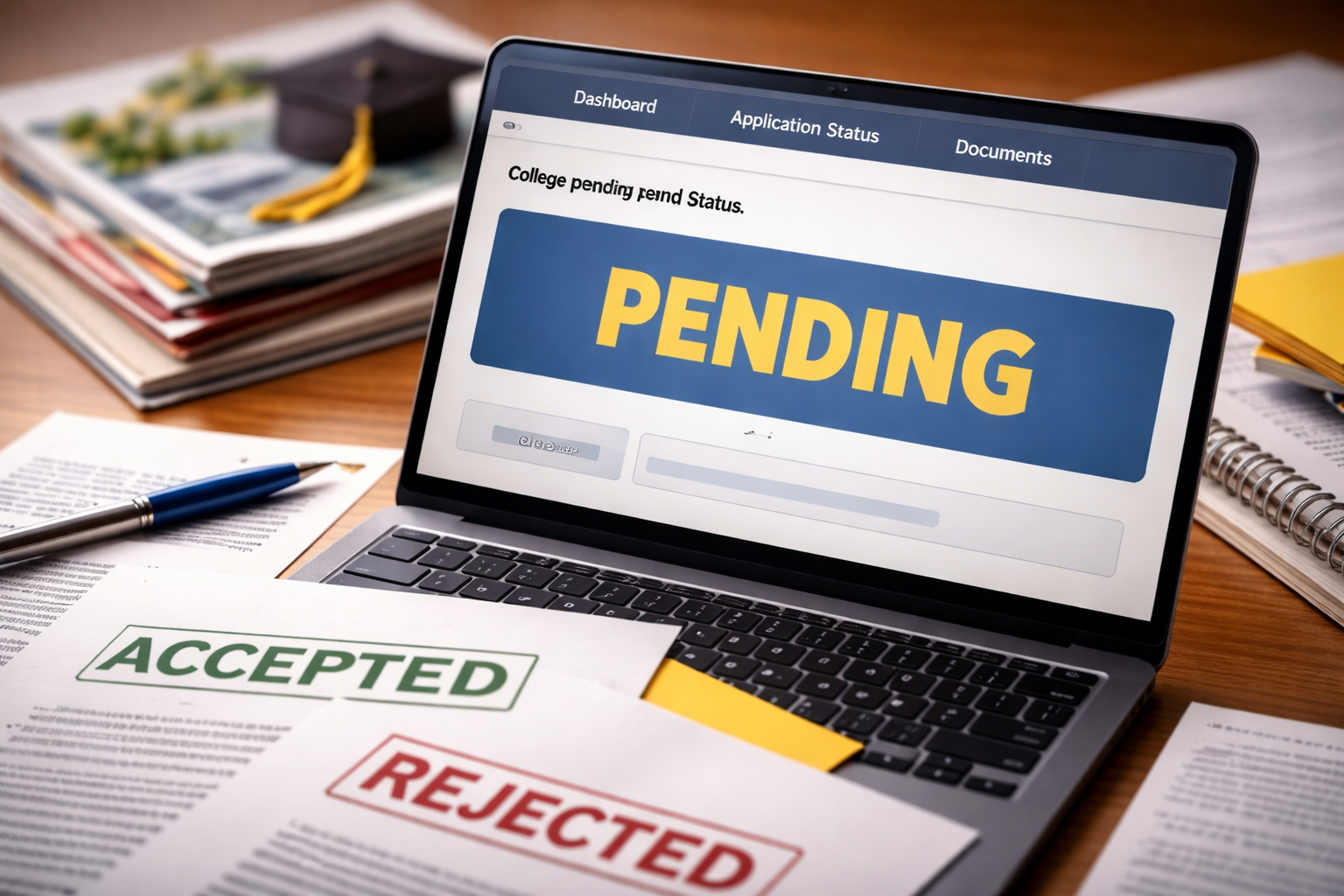
Admission Decision Says Pending After Release was the exact phrase I searched when I logged into the college portal after the published release time and saw that nothing felt normal. Friends were already posting their outcomes. Some had acceptance letters. Some had waitlist notices. Some had clear denials. But my portal showed pending, and that one word was somehow worse than a decision I did not want. It made the whole situation feel unfinished, like the school had moved forward without actually telling me where I stood.
Admission Decision Says Pending After Release creates a very specific kind of panic because the expectation on decision day is simple: by that point, the college should have either posted a decision or clearly delayed it. Seeing pending after the official release date feels like a system problem, a file problem, or a sign that something about the application is still unresolved. In many college admissions systems, though, pending after release does not always mean the decision is missing. It often means the decision workflow and the student-facing portal are no longer moving at the same speed.
If you want to understand how colleges move applicant records through internal status stages before students see them in the portal, this guide gives the closest system-level explanation.
Why this status appears after release
Admission Decision Says Pending After Release usually happens when the college has already moved the application through part of the decision pipeline, but the applicant portal has not finished reflecting the final result. Most students imagine decision release as one instant event. In reality, many colleges use several connected systems. One system holds committee outcomes. Another handles quality control. Another generates student-facing portal messages. Another triggers email notifications. If even one layer lags behind, the visible result can be pending after the release date has already arrived.
That does not automatically mean the college forgot the file. It also does not automatically mean the student was denied, waitlisted, or flagged for a serious issue. Admission Decision Says Pending After Release often appears because the institution released decisions in a controlled sequence rather than in one perfectly synchronized moment.
At many colleges, the decision process may look more like this:
- committee decision entered internally
- status reviewed for consistency and coding accuracy
- special populations or exception files checked separately
- decision batches prepared for portal publication
- student portal updated
- email notification sent later
That is why one applicant can see a final answer while another sees pending even though both applied to the same college and both checked at nearly the same time.
The most common case branches
Case 1: Batch release delay
The college is releasing decisions in waves. Your file may already be finished internally, but your batch has not yet been pushed to the portal. In this version, Admission Decision Says Pending After Release is mostly a timing problem between one release group and the next.
Case 2: Final verification still running
Some files go through an extra check right before publication. This may happen if there was a residency question, transcript inconsistency, identity check, major-specific seat issue, or application-data mismatch. In that situation, Admission Decision Says Pending After Release can mean the file is not back at committee review but is still being cleared for safe release.
Case 3: Portal status lag
The internal decision exists, but the public portal did not refresh properly. This is especially common on high-traffic decision days. When thousands of applicants log in at once, student-facing systems can lag behind internal status changes. In this version, Admission Decision Says Pending After Release may disappear later the same day without any intervention.
Case 4: Document reconciliation issue
If a transcript, recommendation, score report, fee posting, or school form was updated close to release time, the college may temporarily stop the status from finalizing in the portal. Here, Admission Decision Says Pending After Release may reflect a system trying to reconcile inputs rather than a fresh evaluation of your whole candidacy.
Case 5: File diverted to a smaller review queue
Sometimes a college needs a file moved out of the main release lane into a narrower queue. That can happen for institutional research checks, scholarship coordination, disciplinary verification, duplicate-record cleanup, or decision coding review. If so, Admission Decision Says Pending After Release can last longer than a simple portal lag.
These branches matter because they change what you should do next. If the problem is a same-day portal lag, repeated panic emails do not help. If the problem is a file-level hold, waiting too long without checking can leave you in the dark when a simple clarification would have moved things forward.
How colleges often see this internally
Student portals are simplified on purpose. Colleges usually do not want applicants seeing raw operational codes, conflicting queue labels, or internal exception notes. So the student side gets broad labels like pending, under review, incomplete, or update coming soon. Internally, however, the file may sit under much more specific status logic.
Examples can include labels such as:
- decision entered, not published
- publication queue assigned
- manual review clearance pending
- status synchronization incomplete
- communication hold before release
- decision record mismatch under correction
This is why Admission Decision Says Pending After Release can look dramatic from the outside while being relatively routine from the institution’s point of view. The problem is not that students are overreacting. The problem is that the public wording is too broad for a moment that feels extremely high stakes.
If your file seems stuck well beyond normal portal timing, this related article covers the longer version of that same uncertainty.
When pending is probably harmless
Admission Decision Says Pending After Release is often harmless when the college clearly announced a broad release window rather than a guaranteed minute-by-minute release time. It is also less alarming when other students are reporting staggered updates, when the portal is slow for everyone, or when the college is known to release by school, major, region, or application round in stages.
A short pending period is especially common when:
- the college uses rolling technical publication after a fixed date
- email notices trail the portal by several hours
- different applicant groups are released in separate batches
- the portal is under heavy traffic load
In these situations, Admission Decision Says Pending After Release may simply mean your visible portal has not caught up yet.
When pending may signal a real file issue
There are also situations where Admission Decision Says Pending After Release deserves more attention. The clearest warning sign is not the word pending by itself. It is the combination of pending with other irregular details.
- missing documents suddenly reappear in the checklist
- the application term looks wrong
- the portal shows contradictory status messages
- a decision release date passed and several days went by with no movement
- you received an identity, residency, or record-verification request
That combination suggests the file may have been pulled out of the standard release path. It does not always mean something serious happened, but it does mean the issue may not resolve through passive waiting alone.
If your portal behavior looks less like a clean delay and more like missing or inconsistent output, this article is the best next comparison point.
What students and parents should do now
If Admission Decision Says Pending After Release appears in a college application portal, the best response is controlled and specific.
- Take screenshots of the portal status, date, and time.
- Check whether the college announced decisions would come in waves or over a release window.
- Review the checklist for missing transcripts, scores, recommendations, fees, or identity items.
- Wait through the stated release window before assuming the school made an error.
- If the pending status remains after that window, contact admission with a concise question tied to the portal status.
The key is not sending a long emotional message. Ask a narrow operational question. For example: “My college application portal still shows pending after the official release date. Can you confirm whether my admission decision is still awaiting portal update or whether there is an unresolved item on my file?”
That wording is stronger than “Did something go wrong?” because it gives the admission office two concrete paths to answer.
What not to do
Do not assume Admission Decision Says Pending After Release means rejection. Do not compare your exact timing to every other applicant on social media. Do not keep refreshing the portal every minute during a heavy release period. Do not send multiple emails in a row before the college’s own release window has ended. And do not ignore newly reappearing checklist items if the portal starts showing them again.
One of the biggest mistakes applicants make is collapsing different problems into one fear. A pending status after release is not the same as a missing decision, not the same as an incorrect decision posting, and not the same as an admission reversal after acceptance. Treating every unclear portal status as the worst-case outcome makes it harder to respond in a measured way.
Official admission guidance
College admission timelines and communication practices vary by institution, but the National Association for College Admission Counseling provides general guidance and resources on college admission practices and decision communication. This is useful background if you want a credible, broad overview of how admission processes are structured.
National Association for College Admission Counseling – College Admission Resources
Key Takeaways
- Admission Decision Says Pending After Release is usually a portal-status timing problem, not automatic bad news.
- Colleges often separate internal decision completion from public portal publication.
- The most important clues are duration, missing items, and contradictory portal details.
- A short pending status can be normal; a prolonged one deserves direct clarification.
- A concise, specific message to admissions works better than a broad panic email.
FAQ
Does Admission Decision Says Pending After Release mean I was denied?
No. In many cases it means the visible portal has not completed its update, not that the outcome is negative.
How long can pending last after the release date?
Sometimes only a few hours. If it lasts beyond the school’s stated release window or continues for more than a day or two without explanation, it is reasonable to ask for clarification.
Should I contact the college immediately?
Wait through the official release window first. After that, a concise message is appropriate if Admission Decision Says Pending After Release remains unchanged.
What should I include in my message?
Include your full name, applicant ID if available, the exact portal wording, and the date and time you saw the status.
Admission Decision Says Pending After Release is frustrating because it lands in the worst possible space between silence and closure. It gives just enough information to create stress and not enough information to create confidence. But that does not mean the file is broken or that the result is automatically negative. In many college admission systems, this status is simply the visible sign of a release process that is still catching up.
If your college application portal still shows Admission Decision Says Pending After Release, document the status, review your checklist, wait through the school’s stated release window, and then contact the admission office with a narrow question that asks whether the file is awaiting portal update or whether an unresolved item remains. Do that today if the release window has already passed, because the fastest way out of uncertainty is to force the status into a clear operational answer.