
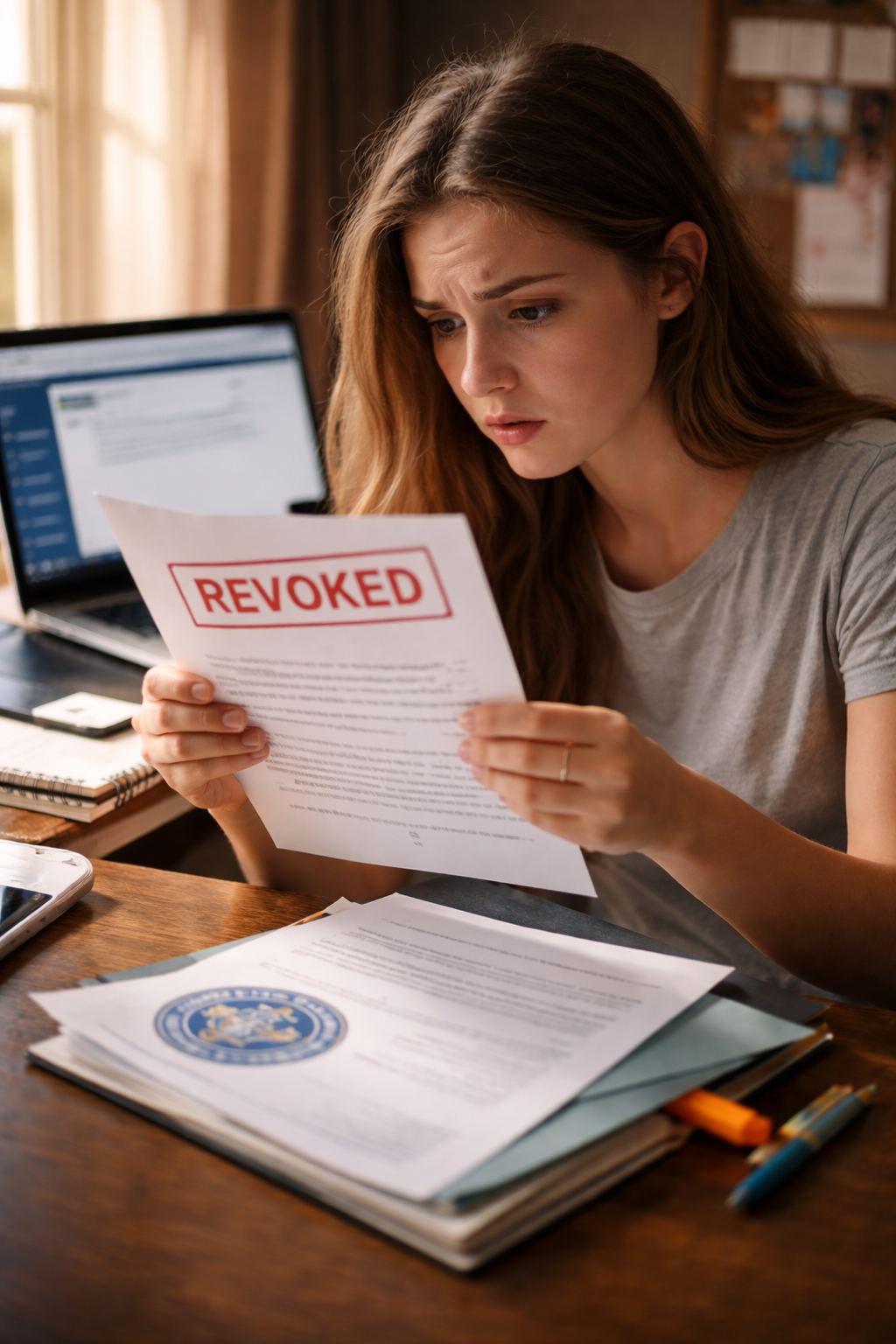
College acceptance withdrawn after accepting happened in the least dramatic way possible: one quiet portal refresh and a status line that didn’t match my reality. I’d already put down the deposit, declined other offers, and started lining up housing. I wasn’t even “checking” anymore—just logging in to confirm an orientation date. Then the acceptance line was gone, replaced by wording that sounded like a legal memo.
For a minute I just stared at it, trying to translate the sentence into something normal. It didn’t feel real because nothing in my life had changed—until I realized the system had changed my life anyway. If you’re reading this because you just saw a college acceptance withdrawn after accepting notice, your next 24 hours matter more than your next 24 days.
Before you assume you were “revoked,” confirm you’re not dealing with a portal problem, a mismatch between systems, or a temporary review flag that looks final. I’ve seen students waste days arguing about fairness when the first move should’ve been verifying the status change and requesting the exact basis in writing.
First, check whether your portal history is behaving strangely (missing letters, blank screens, disappearing sections). If anything looks inconsistent, start here:
What This Usually Means (Without the Lecture)
A college acceptance withdrawn after accepting message often lands in one of two buckets: a temporary administrative hold that’s poorly worded, or a formal withdrawal triggered by a specific concern. Schools do not always label those buckets clearly. Many portals display a generic “withdrawn” line even when the internal file notes say “pending review.”
Your job is to force the situation into clarity—politely, quickly, and with documentation.
Fast Reality Check (2 minutes)
- Did you receive a separate PDF letter in the portal?
- Does the message include a date/time and an office signature?
- Is there a “contact us” instruction with a deadline?
- Did you recently submit a final transcript, mid-year report, or updated document?
If you have a dated letter and a deadline, treat it as real and act immediately. If it’s only a single status line with no letter, treat it as urgent—but also treat “system error” as plausible.
Why Colleges Do This After You’ve Already Accepted
In a college acceptance withdrawn after accepting situation, the college is usually reacting to information that they believe changes risk. Sometimes that information is accurate; sometimes it’s incomplete; sometimes it’s misfiled; sometimes it’s a misunderstanding that becomes “true” only because no one corrected it fast enough.
From the institution’s side, the review commonly centers on:
- Whether the original decision relied on accurate academic or personal information
- Whether something material changed after the offer
- Whether the college followed its own published process
Even if the letter sounds final, many colleges still allow clarification submissions. The students who recover are usually not the ones with the most dramatic story—they’re the ones who respond like someone who understands the system.
Identify Your Scenario in 60 Seconds
Pick the path that matches what happened
- Path A: You got a clear letter listing a reason (grades, discipline, application issue, conduct, documentation).
- Path B: The portal changed, but there’s no letter and staff responses are vague.
- Path C: The letter says “pending review” or “hold,” and asks for documents or an explanation.
- Path D: You suspect the school mixed up your record (wrong student, wrong transcript, wrong discipline report).
- Path E: The change happened right after you submitted something (final transcript, new test score report, updated residency, or an address change).
Now follow the matching section below. Do not try to “argue the whole case” in the first message. Your first message should be short, calm, and designed to get the file back into review with correct facts.
Path A: There’s a Stated Reason (Grades, Conduct, or “Inconsistency”)
If the letter specifies a reason, your goal is to respond in a way that makes it easy for the college to say “we reviewed the additional context” without feeling like they’re setting a precedent.
What to send within 24 hours
- A brief email acknowledging receipt and requesting the specific policy or standard applied
- Any relevant documents in a single PDF packet (not 12 attachments)
- A timeline of facts (3–6 bullet points, with dates)
- A request for the next step: “Is there an appeal or clarification process?”
Do not accuse, threaten, or speculate. Focus on verifiable facts. If your grades dipped, explain what changed, what’s stabilized, and how you will meet expectations. If the issue is “inconsistency,” identify the exact line item and provide proof.
Many students facing college acceptance withdrawn after accepting panic and overshare. Oversharing creates new confusion. You want the opposite: clean, limited, precise.
Path B: No Letter, Just a Portal Change
This is where students lose time. If you only have a portal status change, you should assume it could be either a system sync issue or a real internal update that simply hasn’t been published to you yet.
Here’s the move that works: ask for confirmation of status and the presence of a formal decision document. You are not begging—you are requesting administrative clarity.
Portal-Only Status Change Script (copy your own words)
- “I’m seeing a status update in my portal that appears inconsistent with my prior acceptance. Could you confirm my current admission standing and whether a formal decision letter has been issued?”
- “If a review is underway, please let me know what materials you need from me and by what deadline.”
If they reply by phone, immediately email back summarizing what was said. Written records keep the process fair and reduce misunderstandings.
If you are currently stuck in “unclear status language,” this related guide may help you interpret what the portal wording usually signals (and what it usually does not):
Path C: “Pending Review” or “Hold” (This Is a Window)
When college acceptance withdrawn after accepting is framed as a review, that’s often your best-case scenario—because the institution is still deciding and is more open to documentation.
Your objective is to submit a complete, organized response before they finalize the file without you.
Build a 1-Packet Response (simple, professional)
- Page 1: one-paragraph statement + 5-bullet timeline
- Pages 2–3: supporting documents (transcript note, counselor letter, official emails)
- Final page: your request (“Please confirm receipt and next steps.”)
Keep your tone cooperative. Systems reward cooperation. This is not the moment to write a long emotional essay. You can be human while still being structured.
Path D: You Think They Mixed Up Your Record
This happens more than people want to believe. Names are similar. School codes are similar. Transcripts get scanned. A disciplinary note can be misattached. If you suspect record mix-up, you need to say it without sounding accusatory.
Use neutral language: “possible mismatch,” “verification,” “confirm identifiers.”
Record Verification Checklist
- Ask them to confirm your full legal name and date of birth on file (or applicant ID)
- Confirm the high school name and graduation year used
- Confirm the specific document that triggered the change
- Offer to provide an official re-send (transcript/test score) from the issuing institution
When systems are wrong, precision beats passion. This approach gives staff a face-saving way to correct the file.
Path E: It Happened After You Sent Something (Transcript, Scores, Residency)
If college acceptance withdrawn after accepting showed up right after you submitted a final transcript, test scores, or an updated form, your file may have been auto-flagged for review. Sometimes that review is routine; sometimes it exposes a mismatch. Either way, your best move is to request a clear explanation of what the new item changed in their evaluation.
If the issue may involve education records and access, you can review general privacy protections under FERPA. This is not legal advice—just an official starting point for understanding how student records are handled.
Case Branch Box: What to Do If They Won’t Respond
If you’ve emailed twice and heard nothing
- Step 1 (Day 1): Email admissions + copy your regional counselor if listed.
- Step 2 (Day 2): Call, ask for the correct email for “admission standing review,” then send a written recap.
- Step 3 (Day 3): Ask whether there is a formal appeals channel or committee review schedule.
- Step 4 (Same day): Start backup options (see next section) while your review is pending.
Silence is not proof you lost. It often means your message is sitting in a queue. Your goal is to stay persistent without becoming hostile.
Protect Your Backup Options Without “Starting Over”
When college acceptance withdrawn after accepting hits, you should immediately protect alternatives—even if you believe the college will reverse the decision. Doing this is not giving up. It’s risk management.
- Contact previously admitted schools (some can reopen your spot quickly)
- Ask whether your declined offer can be reconsidered due to changed circumstances
- Check if your intended college offers deferral or reinstatement pathways
- Secure transcript and test score delivery proof for any new submission
The worst outcome is losing time and losing options. You can push an appeal and protect backups at the same time.
To understand the most common reasons schools take back an offer (and how to avoid triggering new problems while you respond), read this next:
Absolute Mistakes That Turn a Review Into a Permanent Loss
In nearly every college acceptance withdrawn after accepting story that ends badly, the final damage comes from avoidable mistakes—especially communication mistakes.
- Sending angry or sarcastic emails that get forwarded internally
- Threatening lawsuits or media before you have facts
- Posting accusations publicly while the review is open
- Submitting new documents that contradict your own timeline
- Missing their requested deadline because you were “waiting to hear back”
Professional tone is not weakness; it’s leverage.
FAQ
Is college acceptance withdrawn after accepting always final?
Not always. It may be a temporary hold or a decision pending review. Your quickest path is to request the exact basis and the next step in writing.
Should I call admissions or only email?
Call if you need speed, but always follow up by email summarizing what was said. Written records reduce “he said / she said” later.
What if the reason is a grade drop?
Respond with facts: what changed, what stabilized, and what support plan exists. Keep it short and documented. Many colleges review context if you respond promptly.
What if it’s a portal error?
Ask whether a formal decision letter exists and request confirmation of current standing. Portal-only changes sometimes reflect syncing delays.
Should I contact other colleges right away?
Yes. Protect your options immediately while you pursue clarification or review. It’s common to run both tracks.
Key Takeaways
- A college acceptance withdrawn after accepting notice can be a review window, not the end.
- Respond within 24 hours with calm, structured questions and a clean packet of proof.
- Match your response to the exact scenario (reason stated vs portal-only vs hold).
- Keep everything in writing, even if you talk by phone.
- Protect backup options immediately to avoid time-based losses.
What to Do Right Now (Do This Today)
If you’re in a college acceptance withdrawn after accepting situation, do these in order:
Today’s 5-Step Plan
- Step 1: Screenshot the portal and save/download any letter PDFs.
- Step 2: Email admissions requesting the exact basis, the status (review vs final), and the deadline.
- Step 3: Build a one-packet response with a timeline and proof (single PDF).
- Step 4: If no response, call and then email a written recap.
- Step 5: Contact at least one backup school within 48 hours.
Right before you hit send, take 30 seconds to read your message like the staff member who has to forward it to a committee. If it sounds emotional, rewrite it. If it sounds clean and factual, send it.
Finally, it can help to understand how and why decisions sometimes shift after release—especially if your portal language keeps changing while you wait:
College acceptance withdrawn after accepting can feel like your future got rewritten without your consent. But admissions decisions are processed through systems—and systems can be reviewed, clarified, and sometimes corrected. Your job is not to carry the blame. Your job is to move fast, document everything, and keep doors open.
Do the next action now: send the clarification email today, build the one-packet response tonight, and protect one backup option within 48 hours. That’s how you turn shock into control.